Showing posts with label Jesus. Show all posts

Friday, April 25, 2025

“Lord, Is It I?”

20 Now when the even was come, [Jesus] sat down with the twelve.
21 And as they did eat, he said, Verily I say unto you, that one of you shall betray me.
22 And they were exceeding sorrowful, and began every one of them to say unto him, Lord, is it I? (New Testament | Matthew 26:20-22)
At some time or other (and probably many times in a lifetime), the answer to that question for every human is “yes.” And if we look beyond self to our divinely-appointed nations, the answer is also “yes.” The scriptures are one long litany of betrayal after betrayal of truth and light till the uncircumcised like Assyria and Babylon were called upon to punish the betrayal.
25 ¶ Behold, the days come, saith the LORD, that I will punish all them which are circumcised with the uncircumcised;
26 Egypt, and Judah, and Edom, and the children of Ammon, and Moab, and all that are in the utmost corners, that dwell in the wilderness: for all these nations are uncircumcised, and all the house of Israel are uncircumcised in the heart (Old Testament | Jeremiah 9:25–26).
When we read scripture, especially Isaiah, Jeremiah and the  Book of Mormon, we see how the pattern repeats and repeats. Having all these scriptural witnesses exposing the nature of the natural man, do we think we have escaped the pattern of betrayal? Or is ours more hidden? more layered with pretense? suffocated with denial?

If we consider North American, which we “People of the Books”1 understand to be a divinely-appointed land of Zion, can we finally acknowledge in 2025 that we are in the grip of that pattern of betrayal of the good that was fought for in the 1700 and 1800s on this continent? that the underbelly of our nations has contributed more to the burgeoning beast of Babylon than any other because of prideful preeminence in science, wealth, military power, technology, manifest destiny, etc, etc.? On the surface, we still preach freedom, democracy, ethics, equality, tolerance, fairness, Constitution, justice, judgment, and on and on, yet in secret chambers, our intelligence agencies and our power- and global-elites conspire for greater power, gain, glory, and, above all, domination. The evidence is recorded everywhere — for over a century — but we keep ignoring it (or shelving it under fiction or “conspiracy theory”) and re-electing, re-appointing, elevating many of the same generational power-abusers and ideologues over and over. The Balaam strategy2 of corrupt and conquer is in full swing. Ask: what nation exports the most corrupted "entertainment" and hypocrisy? Do we imagine that the good we do excuses, counterbalances, or outweighs the horrifying evils? Do we really think Babylon is collapsing because of recent events? Read Jeremiah, a prophet unto the nations,3 and substitute North America 2025 for the accusations and ask “Is it WE?”

And if it is, we may already have our "uncircumcised" Nebuchadnezzar at work performing his service for God until he too exceeds his authority and needs his own punishment.4 In the meantime, we may still have time to wake-up and cleanup, both personally and nationally.

Perhaps begin with a chronological reading and reflection of Jeremiah. As some students of scripture have discovered, Jeremiah was not compiled in true chronology,5 so I set out below the footnotes, an ordered chronology with chapter headings to show in summary the dire and deteriorating state of the kingdom of Judah (and all those other nations God names). In my view, until we see history and our own times in light of this repeating cycle of pride and betrayal, we will never understand the necessity of a Nebuchadnezzar nor the "treasonous" words of Jeremiah in chapter 27.

In company with Jeremiah, the extensive exposés ("revelations") of investigative journalists like George Webb,6 journalist / historical analyst Peter Duke,7 and many others8 reveal the depth of criminality, corruption, hypocrisy, and staggering betrayal that have got above us9 here in North America because of secret combinations we have ignored or pretended do not exist despite years of historical, recorded proof and pattern. Are we like the offended Nephites denying our betrayals because they don't fit with our self-image or expectations? And if we think that more aggressive Christian Nationalism10 will save us, how is that not a betrayal of the separation of church and state; a betrayal of the divinely-mandated separation of what is Caesar’s and what is God’s11? History has proven time after time that man cannot be trusted to combine church and state. Agency is betrayed by coercion.
4 We believe that religion is instituted of God; and that men are amenable to him, and to him only, for the exercise of it, unless their religious opinions prompt them to infringe upon the rights and liberties of others; but we do not believe that human law has a right to interfere in prescribing rules of worship to bind the consciences of men, nor dictate forms for public or private devotion; that the civil magistrate should restrain crime, but never control conscience; should punish guilt, but never suppress the freedom of the soul (Doctrine and Covenants | Section 134:4).12
--------------------------------------/
1. People of the Books: 1) Bible (Old and New); 2) Book of Mormon; 3) Doctrine and Covenants; and 4) Pearl of Great Price.
2. https://dejavu-timestwo.blogspot.com/2022/11/deja-vu-doctrine-of-balaam-doctrine-of.html
https://dejavu-times.blogspot.com/2020/10/corruption-by-design.html
https://dejavu-times.blogspot.com/2024/04/the-price-of-rice.html
3. Old Testament | Jeremiah 1:5–10
   5 Before I formed thee in the belly I knew thee; and before thou camest forth out of the womb I sanctified thee, and I ordained thee a prophet unto the nations. ...
   10 See, I have this day set thee over the nations and over the kingdoms, to root out, and to pull down, and to destroy, and to throw down, to build, and to plant.
4. Old Testament | Jeremiah 50:17–18
   17 ¶ Israel is a scattered sheep; the lions have driven him away: first the king of Assyria hath devoured him; and last this Nebuchadrezzar king of Babylon hath broken his bones.
   18 Therefore thus saith the LORD of hosts, the God of Israel; Behold, I will punish the king of Babylon and his land, as I have punished the king of Assyria.
5. Biltz, Mark. Decoding the Prophet Jeremiah: What an Ancient Prophet Says About Today Charisma House. Kindle Edition.; Lau, Binyamin. Jeremiah: The Fate of a Prophet (by an Israeli Jewish scholar)
6. https://rumble.com/user/georgewebb/videos
https://x.com/RealGeorgeWebb1
https://georgewebb.substack.com/
7. https://rumble.com/user/TheDukeReport
https://www.youtube.com/@TheDukeReport/videos
https://thedukereport.substack.com/p/ai-on-ai-on-ai-on-if-this-does-not?source=queue
https://thedukereport.substack.com/
8. Only a few out of thousands:
   ● Catherine Austin Fitts at https://www.youtube.com/@thesolarireport
   ● Hall, John. Guinea Pigs: Technologies of Control
   ● Horn, Thomas; Horn, Nita. Forbidden Gates: How Genetics, Robotics, Artificial Intelligence, Synthetic Biology, Nanotechnology, and Human Enhancement Herald The Dawn Of TechnoDimensional Spiritual Warfare
   ● McCoy, Alfred W.. The CIA's Secret Research on Torture: How Psychologists Helped Washington Crack the Code of Human Consciousness
   ● Meerloo, Dr. Joost A. M.. The Rape of the Mind: The Psychology of Thought Control, Menticide, and Brainwashing
   ● Monteith, Dr. Stanley. Brotherhood of Darkness
   ● Prouty, L. Fletcher. The Secret Team: The CIA and Its Allies in Control of the United States and the World
   ● Ross M.D., Colin A.. The CIA Doctors: Human Rights Violations By American Psychiatrists
   ● Ross M.D., Colin A.. Military Mind Control: A Story of Trauma and Recovery
   ● Rutz, Carol. A Nation Betrayed: Secret Cold War Experiments Performed on our Children and Other Innocent People
   ● Scura, John; Phillips, Dane. Battle Hymn: Revelations of the Sinister Plan for a New World Order.
   ● Simpson, Christopher. Science of Coercion: Communication Research & Psychological Warfare, 1945–1960 (Forbidden Bookshelf 13)
   ● Valentine, Douglas. The CIA as Organized Crime: How Illegal Operations Corrupt America and the World. Also The Phoenix Program: America's Use of Terror in Vietnam (Forbidden Bookshelf 5)
9. Book of Mormon | Ether 8:22–25
   22 And whatsoever nation shall uphold such secret combinations, to get power and gain, until they shall spread over the nation, behold, they shall be destroyed; for the Lord will not suffer that the blood of his saints, which shall be shed by them, shall always cry unto him from the ground for vengeance upon them and yet he avenge them not.
   23 Wherefore, O ye Gentiles, it is wisdom in God that these things should be shown unto you, that thereby ye may repent of your sins, and suffer not that these murderous combinations shall get above you, which are built up to get power and gain—and the work, yea, even the work of destruction come upon you, yea, even the sword of the justice of the Eternal God shall fall upon you, to your overthrow and destruction if ye shall suffer these things to be.
   24 Wherefore, the Lord commandeth you, when ye shall see these things come among you that ye shall awake to a sense of your awful situation, because of this secret combination which shall be among you; or wo be unto it, because of the blood of them who have been slain; for they cry from the dust for vengeance upon it, and also upon those who built it up.
   25 For it cometh to pass that whoso buildeth it up seeketh to overthrow the freedom of all lands, nations, and countries; and it bringeth to pass the destruction of all people, for it is built up by the devil, who is the father of all lies; even that same liar who beguiled our first parents, yea, even that same liar who hath caused man to commit murder from the beginning; who hath hardened the hearts of men that they have murdered the prophets, and stoned them, and cast them out from the beginning.
10. https://dejavu-timestwo.blogspot.com/2023/09/5-church-state-christian-nationalism.html
11. New Testament | Matthew 22:17–21
   17 Tell us therefore, What thinkest thou? Is it lawful to give tribute unto Cæsar, or not?
   18 But Jesus perceived their wickedness, and said, Why tempt ye me, ye hypocrites?
   19 Shew me the tribute money. And they brought unto him a penny.
   20 And he saith unto them, Whose is this image and superscription?
   21 They say unto him, Cæsar's. Then saith he unto them, Render therefore unto Cæsar the things which are Cæsar's; and unto God the things that are God's.
12. See the entire Doctrine and Covenants | Section 134

Jeremiah Chronology (per Mark Biltz) with chapter summaries from the KJV of the Bible published by the Church of Jesus Christ of Latter-day Saints.
For 40 plus years (beginning c. 627 BC), the prophet Jeremiah preached of impending destruction of the kingdom of Judah (which also contained remnants of the kingdom of Israel that had been decimated by Assyria about 100 years previous). The three main kings during Jeremiah’s prophetic call were:
     Josiah (641/40 – 609 BC)
     Jehoiakim (609 – 598 BC)
     Zedekiah (597 – 586 BC)
Note: the dating of reigns is mostly taken from Edwin R. Thiele, The Mysterious Numbers of the Hebrew Kings, © 1983 The Zondervan Corporation (New Revised Edition, 1994 by Kregel Publications)

During reign of king Josiah (641/40–609 BC)
CHAPTER 1: Jeremiah foreordained to be a prophet unto the nations—He is called, as a mortal, to declare the word of the Lord. [Circa 627 BC]
CHAPTER 3: Israel and Judah defiled and polluted the land through wickedness—In the last days, the Lord will gather Israel, one of a city and two of a family, and bring them to Zion.
CHAPTER 14: Jeremiah prays because of dearth and famine—The Lord will not hear because of the wickedness of his people.
CHAPTER 17: Captivity of Judah comes because of sin and forsaking the Lord—Hallow the sabbath day: such shall save the people; otherwise they shall be destroyed.
CHAPTER 11: The Jews are cursed for breaking the covenant of obedience—The Lord will not hear their prayers.
CHAPTER 12: Jeremiah complains of the prosperity of the wicked—If other nations learn the ways of Israel, they shall be numbered with them.
CHAPTER 9: Jeremiah bewails the sins of the people—They will be scattered among the heathen and punished.
CHAPTER 15: The Jews shall suffer death and the sword and famine and captivity—They shall be removed into all the kingdoms of the earth—Jerusalem shall be destroyed.
CHAPTER 16: Utter ruin of the Jews foreseen—Israel rejected and scattered for serving false gods—Fishers and hunters shall gather them again, and they shall serve the Lord—Gospel to be restored for last time.
CHAPTER 7: If Jerusalem repent she shall be preserved—The temple has become a den of robbers—The Lord rejects that generation of Jews for their idolatries—They offer their children in sacrifices.
CHAPTER 18: Israel is as potter's clay in the hands of the Lord—If nations repent, the Lord withholds the evil decreed against them—The Jews shall be scattered.
CHAPTER 19: The Lord will bring evil upon Judah—They sacrificed their children to Baal—In the siege they shall eat the flesh of their sons and daughters.
CHAPTER 2: The Jews forsook the Lord, the fountain of living waters—They changed their gods, worshipped idols, and rejected the prophets.
During reign of king Jehoiakim (c. 609–598 BC — a son of king Josiah)
CHAPTER 26: Jeremiah prophesies the destruction of the people—For this he is arraigned and tried and then acquitted. [Circa 604 BC]
CHAPTER 27a: The Lord sends word to many nations that they are to serve Babylon—[27b] The vessels of the Lord's house shall go into Babylon.
CHAPTER 25: Captive Judah shall serve Babylon seventy years—Divers nations shall be overthrown—In the last days all the inhabitants of the earth shall be at war.
CHAPTER 22: David's throne stands or falls on the degree of obedience of the kings—The judgments of the Lord rest upon the kings of Judah.
CHAPTER 45: Jeremiah promises Baruch that his life shall be preserved.
CHAPTER 36: Baruch writes the prophecies of Jeremiah and reads them in the house of the Lord—Jehoiakim the king burns the book, and judgment comes upon him—Jeremiah dictates the prophecies again and adds many more.
CHAPTER 13: Israel and Judah shall be as a rotted and decayed girdle—Repentance enjoined—Judah shall be taken captive and scattered as stubble.
CHAPTER 35: The Rechabites are commended and blessed for their obedience—They are given a new commandment.
CHAPTER 4: Israel and Judah called to repentance—Jeremiah laments for the miseries of Judah.
CHAPTER 5: Judgments shall be poured out upon the Jews because of their sins—Their iniquities cause blessings to be withheld from them.
CHAPTER 6: Jerusalem shall be destroyed because of her iniquity—She shall be overrun by a great and cruel nation.
CHAPTER 8: Calamities shall befall the inhabitants of Jerusalem—For them the harvest is past, the summer is ended, and they are not saved.
CHAPTER 10: Learn not the way of the heathen—Their gods are idols and molten images—The Lord is the true and living God.
CHAPTER 23: The remnants of Israel shall be gathered in the last days—King Messiah (the Branch) shall reign in righteousness—False prophets who teach lies shall be cursed.
During reign of king Zedekiah (597-586 BC — another son of king Josiah)
CHAPTER 30: In the last days, Judah and Israel shall be gathered to their own lands—David their king (Christ) shall reign over them.
CHAPTER 31: In the last days, Israel shall be gathered—Ephraim has the birthright as the firstborn—The Lord will make a new covenant with them, to be inscribed in the heart—Then shall they all know the Lord.
CHAPTER 24: Zedekiah and the Jews shall be cursed and scattered—Some shall be gathered back from Chaldea to serve the Lord.
CHAPTER 29: Jeremiah tells Jews in Babylon to prepare for seventy years of captivity—Those remaining in Jerusalem shall yet be scattered—Shemaiah prophesies falsely and is cursed.
CHAPTER 46: Jeremiah prophesies the conquest of Egypt by Babylon—Jacob shall be saved and return to his own land.
CHAPTER 47: Jeremiah foretells desolation and destruction upon the Philistines.
CHAPTER 48: Judgment and destruction shall come upon Moab for their contempt of God.
CHAPTER 49: Judgment and destruction shall come upon the Ammonites, Edom, Kedar, Hazor, and Elam.
CHAPTER 50: Babylon shall be destroyed and never rise again—Scattered Israel shall be brought again into the lands of her inheritance.
CHAPTER 51: Judgments and destruction and desolation shall come upon Babylon for her sins—Israel is commanded: Flee ye from Babylon—Israel is the Lord's rod to destroy all kingdoms.
CHAPTER 27b: [a]The Lord sends word to many nations that they are to serve Babylon—[b]The vessels of the Lord's house shall go into Babylon.
CHAPTER 28: Hananiah prophesies falsely that the Babylonian yoke will be broken.
CHAPTER 21: Jeremiah foretells the siege and captivity and destruction of Jerusalem—Zedekiah to be taken captive by Nebuchadrezzar.
CHAPTER 20: Jeremiah is smitten and put in the stocks—He prophesies that all Judah shall be taken captive by Babylon.
CHAPTER 37: Jeremiah prophesies that Egypt shall not save Judah from Babylon—He is cast into a dungeon—Zedekiah transfers him to the court of the prison.
CHAPTER 34: Jeremiah prophesies the captivity of Zedekiah—The Jews shall be removed into all the kingdoms of the earth.
CHAPTER 33: Judah and Israel shall be gathered—Christ the Branch of righteousness is promised—The Seed of David shall reign forever.
CHAPTER 38: The princes cast Jeremiah into a miry dungeon—He is freed by Ebed-melech, an Ethiopian, and put in the court of the prison—He counsels Zedekiah concerning the war.
CHAPTER 32: Jeremiah is imprisoned by Zedekiah—The prophet purchases land to symbolize the return of Israel to their land—The Lord will gather Israel and make an everlasting covenant with them.
CHAPTER 39: Jerusalem is taken and the people captivated—Jeremiah and Ebed-melech, the Ethiopian, are preserved.
CHAPTER 40: The king of Babylon makes Gedaliah governor over the remnant of Jews left in Judah—Jeremiah is freed and dwells among them.
CHAPTER 41: Ishmael kills Gedaliah and carries people of Mizpah captive—They are rescued by Johanan.
CHAPTER 42: Jeremiah promises Johanan and the remnant of Judah peace and safety if they remain in Judah, but a sword and famine and pestilence if they go to Egypt.
CHAPTER 43: Johanan carries Jeremiah and the remnant of Judah into Egypt—Jeremiah prophesies that Babylon shall conquer Egypt.
CHAPTER 44: Jeremiah prophesies that the Jews in Egypt, save a small remnant, shall be destroyed because they worship false gods.
CHAPTER 52: Jerusalem besieged and taken by the Chaldeans—Many people and the vessels of the house of the Lord carried into Babylon.

Monday, October 30, 2023

When to Disrespect “Authority”? Reconciling Jesus* and Paul**?

- Pillars of Freedom -
Sustaining ONLY that
which deserves sustaining
First, let me be clear: I believe that law,1 governments, and authorities2 are necessary because of the predilections of the “natural man.” Scripture states:
the natural man is an enemy to God [and thus to fellow men], and has been from the fall of Adam, and will be, forever and ever, unless he yields to the enticings of the Holy Spirit, and putteth off the natural man ... .3
In proof of that judgment, the natural man has demonstrated over millennia that he cannot be trusted with unrestrained power or authority.4 Even with checks and balances, the déjà vus of corruption,  oppression, and violence have been the way of the world as tyrants (from within family structures all the way to global empires) have risen and then fallen to other tyrants — age upon age. The Scriptures are, in essence, one long lament5 about abuses of power and authority by “natural men” (both high and low) counterbalanced with God's invitation for them to repent, accept and live truth, serve Him and their fellow man, and fill the measure of their creation, all without coercion. 

But what characterizes the natural man? In large measure, the natural man is susceptible to:
• self-delusion / self-deception,
• self-aggrandizement,
• obsessions for power-gain-glory-domination,
• acting without conscience,
• pride,
• addiction,
• gullibility,
• misplaced trust,
• lying,
• stiffneckedness,
• and so forth.
Many seek to be a law unto themselves and thus become enemies to God, their fellow beings, and all creation.

So what are we to do when “natural men” gain positions of authority which they often relentlessly pursue, obtain, corrupt, and abuse? What then are we to make of Paul’s instruction in New Testament Romans?
1 LET every soul be subject unto the higher powers. For there is no power but of God: the powers that be are ordained of God.
2 Whosoever therefore resisteth the power, resisteth the ordinance of God: and they that resist shall receive to themselves damnation.
3 For rulers are not a terror to good works, but to the evil. Wilt thou then not be afraid of the power? do that which is good, and thou shalt have praise of the same:
4 For he is the minister of God to thee for good. But if thou do that which is evil, be afraid; for he beareth not the sword in vain: for he is the minister of God, a revenger to execute wrath upon him that doeth evil.
5 Wherefore ye must needs be subject, not only for wrath, but also for conscience sake.
6 For for this cause pay ye tribute also: for they are God's ministers, attending continually upon this very thing.
7 Render therefore to all their dues: tribute to whom tribute is due; custom to whom custom; fear to whom fear; honour to whom honour.
8 Owe no man any thing, but to love one another: for he that loveth another hath fulfilled the law (New Testament | Romans 13:1–8).
Here is one man’s answer worthy of our consideration:
For what purpose has [God] given [dominion of the earth] to the children of men? That they may govern it, even as stated in Gen. 1: 26, 27. This is shown in Rom. 13: 1-4, where it is stated that the powers that be are ordained of God, and that rulers are appointed to bear the sword of justice. The expression, “the powers that be are ordained of God,” refers to authority in general, rather than to particular Governments. And this should be sufficient to show that, although God rules the entire universe, he is not the head of any earthly Government. If he were, then there would be but one correct form of Government, and the officers of that Government would be appointed directly by Him, as in the case of the ancient Jewish Government. But no one can claim that of the various nations of earth, one is ordained of God, to the exclusion of the others.

Take for instance, Russia, Germany, England, and the United States. Here we have four Governments, all differing in their structure. Which of them is ordained of God? All of them. They are all for the purpose of preserving order, and of guarding the rights of each individual against the encroachments of others. This is all that earthly Governments are ordained to do. The whole of the law against the violation of which they can execute wrath is, “Thou shalt love thy neighbor as thyself,” and this they can enforce only so far as concerns outward acts. They cannot compel a man to love his neighbor in his heart, but they can see that he does his neighbor no personal wrong, and when they do this, they are carrying out that for which they were appointed. And in thus executing justice between man and man the ruler is ordained of God, whether he is born to the throne, or whether he is elected by the people, or appointed by a few. The Czar of Russia, the Emperor of Germany, the Queen of England, and the President of the United States, are all equally ordained of God as ministers of justice; not because God is personally at the head of any one of these Governments, but because he has ordained that men shall be under authority, and the individuals above referred to are in authority in their respective Governments. In the discharge of their duty, they are each personally responsible to God, just the same as the humblest peasant.

But, although man was given dominion over the earth and all that it contains, all things are not now under him. Adam was overcome by the tempter, and so forfeited his dominion. He has not now perfect dominion over the earth, because it does not yield to him the increase that it formerly did; and the beasts of the field, the fowl of the air, and the fish of the sea are not passively subject to his control. What man forfeited, he has no power to regain. And so, since we do not now see all things put under him, Paul says that “we see Jesus, who was made a little lower than the angels for the suffering of death, crowned with glory and honor; that he by the grace of God should taste death for every man.” Heb. 2: 9. Not only did Christ taste death in order to restore to man his forfeited life, but he also bore the curse of the earth (compare Gen. 3: 17, 18 and Matt. 27: 29), that he might redeem it, and restore to man the possession that he lost. [52] Since Christ alone could redeem the lost dominion, and has paid the price, it is to him that it is to come. Says the prophet, “And thou, O tower of the flock, the strong hold of the daughter of Zion, unto thee shall it come, even the first dominion; the kingdom shall come to the daughter of Jerusalem.” Micah 4: 8. And so Paul directs the minds of the disciples forward to the time of “the redemption of the purchased possession.” Eph. 1: 14. And when that time shall come, and the kingdom shall be given to Him “whose right it is,” those who have suffered with Christ shall also reign with him. 2 Tim. 2: 12; Rom. 8: 17.6
The prophet Joseph Smith recorded it this way:
12 We believe in being subject to kings, presidents, rulers, and magistrates, in obeying, honoring, and sustaining the law (Pearl of Great Price | Articles of Faith 1:12).

1 WE believe that governments were instituted of God for the benefit of man; and that he holds men accountable for their acts in relation to them, both in making laws and administering them, for the good and safety of society.
2 We believe that no government can exist in peace, except such laws are framed and held inviolate as will secure to each individual the free exercise of conscience, the right and control of property, and the protection of life.
3 We believe that all governments necessarily require civil officers and magistrates to enforce the laws of the same; and that such as will administer the law in equity and justice should be sought for and upheld by the voice of the people if a republic, or the will of the sovereign.
4 We believe ... that the civil magistrate should restrain crime, but never control conscience; should punish guilt, but never suppress the freedom of the soul.
5 We believe that all men are bound to sustain and uphold the respective governments in which they reside, while protected in their inherent and inalienable rights by the laws of such governments; and that sedition and rebellion are unbecoming every citizen thus protected, and should be punished accordingly; and that all governments have a right to enact such laws as in their own judgments are best calculated to secure the public interest; at the same time, however, holding sacred the freedom of conscience.
6 We believe that every man should be honored in his station, rulers and magistrates as such, being placed for the protection of the innocent and the punishment of the guilty; and that to the laws all men show respect and deference, as without them peace and harmony would be supplanted by anarchy and terror; human laws being instituted for the express purpose of regulating our interests as individuals and nations, between man and man; and divine laws given of heaven, prescribing rules on spiritual concerns, for faith and worship, both to be answered by man to his Maker.
7 We believe that rulers, states, and governments have a right, and are bound to enact laws for the protection of all citizens in the free exercise of their religious belief; but we do not believe that they have a right in justice to deprive citizens of this privilege, or proscribe them in their opinions, so long as a regard and reverence are shown to the laws and such religious opinions do not justify sedition nor conspiracy.
8 We believe that the commission of crime should be punished according to the nature of the offense; that murder, treason, robbery, theft, and the breach of the general peace, in all respects, should be punished according to their criminality and their tendency to evil among men, by the laws of that government in which the offense is committed; and for the public peace and tranquility all men should step forward and use their ability in bringing offenders against good laws to punishment.
9 We do not believe it just to mingle religious influence with civil government, whereby one religious society is fostered and another proscribed in its spiritual privileges, and the individual rights of its members, as citizens, denied. ...
11 We believe that men should appeal to the civil law for redress of all wrongs and grievances, where personal abuse is inflicted or the right of property or character infringed, where such laws exist as will protect the same; but we believe that all men are justified in defending themselves, their friends, and property, and the government, from the unlawful assaults and encroachments of all persons in times of exigency, where immediate appeal cannot be made to the laws, and relief afforded. ...(Doctrine and Covenants | Section 134:1-9, 11; full section here7).
The bold emphasis above highlights the conditions for respect for authority. When those conditions were violated or exceeded, neither Jesus nor His servants pretended to respect the offending “authority”; on the contrary, they denounced the corruption and abuse, often in the very face of the abuser.8

The Prophet Joseph also recorded God’s directive concerning government:
4 And now, verily I say unto you concerning the laws of the land, it is my will that my people should observe to do all things whatsoever I command them.
5 And that law of the land which is constitutional, supporting that principle of freedom in maintaining rights and privileges, belongs to all mankind, and is justifiable before me.
6 Therefore, I, the Lord, justify you, and your brethren of my church, in befriending that law which is the constitutional law of the land;
7 And as pertaining to law of man, whatsoever is more or less than this, cometh of evil.
8 I, the Lord God, make you free, therefore ye are free indeed; and the law also maketh you free.
9 Nevertheless, when the wicked rule the people mourn (Doctrine and Covenants | Section 98:4–9, bold emphasis added).
So, when the wicked rule by corrupting or denying Constitutional and just law or limitation, are we to mourn in silence and inaction? Does not authority cease to exist when “authorities” breach or exceed their contract or calling of service to the people? And where is the alleged authority when natural men claim it in elitist self-delusion and self-appointment? Must we not relentlessly remind “authorities” that all governments:
“are all for the purpose of preserving order [without violating rights of conscience9], and of guarding the rights of each individual against the encroachments of others. This is all that earthly Governments are ordained to do”10?
Added October 31 from Cato’s Letter 15 (February 4, 1720):
“That Men ought to speak well of their Governours is true, while their Governours, deserve to be well spoken of, but to do publick Mischief, without hearing of it, is only the Prerogative and Felicity of Tyranny: A free People will be shewing that they are so, by their Freedom of Speech.”11
Added November 3, 2023:
When Should You Defy the Government? | Jonathan Cahn Sermon (YT: Nov 1, 2023)12
---------------------------------/
* Jesus response to corrupted power / authority: https://dejavu-timestwo.blogspot.com/2023/10/respecting-obeying-authority-what-did.html
** Paul: New Testament | Romans 13:1–8 discussed in the body of this post.

1. Doctrine and Covenants | Section 88:34-39
   34 And again, verily I say unto you, that which is governed by law is also preserved by law and perfected and sanctified by the same.
   35 That which breaketh a law, and abideth not by law, but seeketh to become a law unto itself, and willeth to abide in sin, and altogether abideth in sin, cannot be sanctified by law, neither by mercy, justice, nor judgment. Therefore, they must remain filthy still.
   36 All kingdoms have a law given;
   37 And there are many kingdoms; for there is no space in the which there is no kingdom; and there is no kingdom in which there is no space, either a greater or a lesser kingdom.
   38 And unto every kingdom is given a law; and unto every law there are certain bounds also and conditions.
   39 All beings who abide not in those conditions are not justified.
Doctrine and Covenants | Section 88:21–25 (Bold emphasis added.)
   21 And they who are not sanctified through the law which I have given unto you, even the law of Christ, must inherit another kingdom, even that of a terrestrial kingdom, or that of a telestial kingdom.
   22 For he who is not able to abide the law of a celestial kingdom cannot abide a celestial glory.
   23 And he who cannot abide the law of a terrestrial kingdom cannot abide a terrestrial glory.
   24 And he who cannot abide the law of a telestial kingdom cannot abide a telestial glory; therefore he is not meet for a kingdom of glory. Therefore he must abide a kingdom which is not a kingdom of glory.
   25 And again, verily I say unto you, the earth abideth the law of a celestial kingdom, for it filleth the measure of its creation, and transgresseth not the law—
2. Pearl of Great Price | Articles of Faith 1:12
   12 We believe in being subject to kings, presidents, rulers, and magistrates, in obeying, honoring, and sustaining the law.
Doctrine and Covenants | Section 88:34-39
   34 And again, verily I say unto you, that which is governed by law is also preserved by law and perfected and sanctified by the same.
   35 That which breaketh a law, and abideth not by law, but seeketh to become a law unto itself, and willeth to abide in sin, and altogether abideth in sin, cannot be sanctified by law, neither by mercy, justice, nor judgment. Therefore, they must remain filthy still.
   36 All kingdoms have a law given;
   37 And there are many kingdoms; for there is no space in the which there is no kingdom; and there is no kingdom in which there is no space, either a greater or a lesser kingdom.
   38 And unto every kingdom is given a law; and unto every law there are certain bounds also and conditions.
   39 All beings who abide not in those conditions are not justified.
3. Book of Mormon | Mosiah 3:19 
   19 For the natural man is an enemy to God, and has been from the fall of Adam, and will be, forever and ever, unless he yields to the enticings of the Holy Spirit, and putteth off the natural man and becometh a saint through the atonement of Christ the Lord, and becometh as a child, submissive, meek, humble, patient, full of love, willing to submit to all things which the Lord seeth fit to inflict upon him, even as a child doth submit to his father .
See also: https://dejavu-timestwo.blogspot.com/2010/05/natural-man.html
4. Doctrine and Covenants | Section 121:39-40 (bold emphasis added)
   39 We have learned by sad experience that it is the nature and disposition of almost all men, as soon as they get a little authority, as they suppose, they will immediately begin to exercise unrighteous dominion.
   40 Hence many are called, but few are chosen.
See also:
https://dejavu-timestwo.blogspot.com/2016/02/2-flags.html
https://dejavu-times.blogspot.com/2020/08/anarchy-four-fatal-flaws.html
https://dejavu-timestwo.blogspot.com/2020/06/gazlighting-by-anarchists.html
https://dejavu-timestwo.blogspot.com/2018/03/a-few-questions-for-anarchists-and.html
5. https://dejavu-timestwo.blogspot.com/2014/01/gods-lament.html
6. Jones, Alonzo T. . The American Sentinel: Volume 1 (pp. 251-253). Adventist Pioneer Library. Kindle Edition (bold emphasis added).
7. Doctrine and Covenants | Section 134:1-12 (bold emphasis added above)
   1 WE believe that governments were instituted of God for the benefit of man; and that he holds men accountable for their acts in relation to them, both in making laws and administering them, for the good and safety of society.
   2 We believe that no government can exist in peace, except such laws are framed and held inviolate as will secure to each individual the free exercise of conscience, the right and control of property, and the protection of life.
   3 We believe that all governments necessarily require civil officers and magistrates to enforce the laws of the same; and that such as will administer the law in equity and justice should be sought for and upheld by the voice of the people if a republic, or the will of the sovereign.
   4 We believe that religion is instituted of God; and that men are amenable to him, and to him only, for the exercise of it, unless their religious opinions prompt them to infringe upon the rights and liberties of others; but we do not believe that human law has a right to interfere in prescribing rules of worship to bind the consciences of men, nor dictate forms for public or private devotion; that the civil magistrate should restrain crime, but never control conscience; should punish guilt, but never suppress the freedom of the soul.
   5 We believe that all men are bound to sustain and uphold the respective governments in which they reside, while protected in their inherent and inalienable rights by the laws of such governments; and that sedition and rebellion are unbecoming every citizen thus protected, and should be punished accordingly; and that all governments have a right to enact such laws as in their own judgments are best calculated to secure the public interest; at the same time, however, holding sacred the freedom of conscience.
   6 We believe that every man should be honored in his station, rulers and magistrates as such, being placed for the protection of the innocent and the punishment of the guilty; and that to the laws all men show respect and deference, as without them peace and harmony would be supplanted by anarchy and terror; human laws being instituted for the express purpose of regulating our interests as individuals and nations, between man and man; and divine laws given of heaven, prescribing rules on spiritual concerns, for faith and worship, both to be answered by man to his Maker.
   7 We believe that rulers, states, and governments have a right, and are bound to enact laws for the protection of all citizens in the free exercise of their religious belief; but we do not believe that they have a right in justice to deprive citizens of this privilege, or proscribe them in their opinions, so long as a regard and reverence are shown to the laws and such religious opinions do not justify sedition nor conspiracy.
   8 We believe that the commission of crime should be punished according to the nature of the offense; that murder, treason, robbery, theft, and the breach of the general peace, in all respects, should be punished according to their criminality and their tendency to evil among men, by the laws of that government in which the offense is committed; and for the public peace and tranquility all men should step forward and use their ability in bringing offenders against good laws to punishment.
   9 We do not believe it just to mingle religious influence with civil government, whereby one religious society is fostered and another proscribed in its spiritual privileges, and the individual rights of its members, as citizens, denied.
   10 We believe that all religious societies have a right to deal with their members for disorderly conduct, according to the rules and regulations of such societies; provided that such dealings be for fellowship and good standing; but we do not believe that any religious society has authority to try men on the right of property or life, to take from them this world's goods, or to put them in jeopardy of either life or limb, or to inflict any physical punishment upon them. They can only excommunicate them from their society, and withdraw from them their fellowship.
   11 We believe that men should appeal to the civil law for redress of all wrongs and grievances, where personal abuse is inflicted or the right of property or character infringed, where such laws exist as will protect the same; but we believe that all men are justified in defending themselves, their friends, and property, and the government, from the unlawful assaults and encroachments of all persons in times of exigency, where immediate appeal cannot be made to the laws, and relief afforded.
   12 We believe it just to preach the gospel to the nations of the earth, and warn the righteous to save themselves from the corruption of the world; but we do not believe it right to interfere with bond–servants, neither preach the gospel to, nor baptize them contrary to the will and wish of their masters, nor to meddle with or influence them in the least to cause them to be dissatisfied with their situations in this life, thereby jeopardizing the lives of men; such interference we believe to be unlawful and unjust, and dangerous to the peace of every government allowing human beings to be held in servitude.
8. https://dejavu-timestwo.blogspot.com/2023/10/respecting-obeying-authority-what-did.html
https://dejavu-timestwo.blogspot.com/2023/10/respecting-obeying-authority-what-of.html
9. (as long as such conscience is not used to justify sedition or conspiracy against lawful authority)
10. Jones, Alonzo T. The American Sentinel: Volume 1 (pp. 251-253). Adventist Pioneer Library. Kindle Edition (bold emphasis added).
11. Cato's Letters, John Trenchard and Thomas Gordon (Letter Number 15 Of Freedom of Speech, That the Same is inseparable from Publick Liberty, February 4, 1720). Source: https://en.wikiquote.org/wiki/Freedom_of_speech
12. Added Nov 3, 2023:
When Should You Defy the Government? | Jonathan Cahn Sermon
(Jonathan Cahn Official | Nov. 1, 2023 | Time 9:18 min) at
https://www.youtube.com/watch?v=2c4rAz9y2Mo

Sunday, October 15, 2023

Respecting / Obeying “Authority” | What Did Jesus Do?

(JST quotes from http://www.archive.org/details/holyscripturestr00smituoft | New Testament text begins p. 925 of PDF.)

In this time of escalating authoritarianism and its demands for respect and strict obedience, where can we look for guidance on when respect for “authority” is justified and when it is not? Could we look to Jesus’ example?

But let us begin with His forerunner, John:
33 But when he [John] saw many of the Pharisees and Sadducees come to his baptism, he said unto them, O generation of vipers! who hath warned you to flee from the wrath to come?
34 Why is it that ye receive not the preaching of him whom God hath sent? If ye receive not this in your hearts, ye receive not me; and if ye receive not me, ye receive not him of whom I am sent to bear record; and for your sins ye have no cloak.
35 Repent, therefore, and bring forth fruits meet for repentance;
36 And think not to say within yourselves, We have are the children of Abraham, and we only have power to bring seed unto our father Abraham; for I say unto you that God is able of these stones to raise up children unto Abraham [JST NT | Matthew 3:33-36. Source: JST-1867 Holy Scriptures, NT, p. 5].
John was already known as a radical, challenging the religious and civil authorities with his camels’ hair raiment, locusts and wild honey fare, (JST Matthew 3:30; Mark 1:5; KJV 3:4) and blunt, accusatory speech to the point that the civil authorities beheaded him (JST Matthew 14:3-10; Mark 6:18-30, etc.). It seems John was witnessing to the people of his day, and also informing subsequent generations, that corruption was generational, though many didn’t need to be informed because they were already enduring corruption, praying for deliverance, and expecting an avenging Saviour.

So onto the question: Did Jesus follow in His forerunner’s heavy footsteps pertaining to the culture of corrupted authority? Here is Jesus’ opening salvo:
22 For I [Jesus] say unto you, except your righteousness shall exceed that of the Scribes and Pharisees, ye shall in no case enter into the kingdom of heaven (JST New Testament | Matthew 5:22; JST1876-NT, p.7).
We are so used to the image of a meek Jesus, we don’t seem to hear His blunt words directed at the authorities of His day. We seem also to forget that His convicting words and tone were delivered in the hearing of His disciples and attentive multitudes — multitudes who would have little trouble recognizing the  hypocritical behaviors described by Jesus:
2 ... when thou doest thine alms, do not sound a trumpet before thee, as the hypocrites do, in the synagogues and in the streets, that they may have glory of men (JST Matthew 6:2; JST1876-NT. p. 8).

5 ... when thou prayest, thou shalt not be as the hypocrites; for they love to pray standing in the synagogues and in the corners of the streets, that they may be seen of men; (JST Matthew 6:5; JST1876-NT, p. 8).

7 ... when ye pray, use not vain repetitions, as the hypocrites do; for they think that they shall be heard for their much speaking.
8 Therefore be ye not like unto them; (JST Matthew 6:7-8; JST1876-NT, p. 8).

17 Moreover when ye fast, be not as the hypocrites, of a sad countenance; for they disfigure their faces, that they may appear unto men to fast (JST Matthew 6:17-18; JST1876-NT, p. 9).
If we think that criticism of authority was a right exclusive to Jesus, what think ye of this?
6 And Jesus said unto his disciples, Beholdest thou the Scribes, and the Pharisees, and the Priests, and the Levites? They teach in their synagogues, but do not observe the law, nor the commandments; and all have gone out of the way, and are under sin.
7 Go thou and say unto them, Why teach ye men the law and the commandments, when ye yourselves are the children of corruption?
8 Say unto them, Ye hypocrites, first cast out the beam out of thine own yes; and then shalt thou see clearly to cast out the mote out of thy brother’s eye.
9 Go ye into the world, saying unto all, Repent, for the kingdom of heaven has come nigh unto you (JST Matthew 7:6-9; JST1876-NT, p. 10).
And what too of these accusing words?
18 Then said the Pharisees unto him, Why will ye not receive us with our baptism, seeing we keep the whole law?
19 But Jesus said unto them, Ye keep not the law. If ye had kept the law, ye would have received me, for I am he who gave the law.
20 I receive not you with your baptism, because it profiteth you nothing.
21 For when that which is new is come, the old is ready to be put away (JST Matthew 9:3-14, 18-21; JST1876-NT, pp. 12-13).

29 And Jesus said [to the Pharisees], O ye generation of vipers! how can ye, being evil, speak good things? For out of the abundance of the heart the mouth speaketh (JST Matthew 12:29; JST1876-NT, p. 17).

33 Then certain of the Scribes and of the Pharisees answered, saying, Master, we would see a sign from thee. But he answered and said unto them,
34 An evil and adulterous generation seeketh after a sign; (JST Matthew 12:33-34; JST1876-NT, p. 17).

1 Then came to Jesus Scribes and Pharisees, which were of Jerusalem, saying,
2 Why do thy disciples transgress the tradition of the elders? For they wash not their hands when they eat bread.
3 But he answered and said unto them, Why do ye also transgress the commandment of God by your traditions?
4 For God commanded, saying, Honour thy father and mother; and, He that curseth father or mother, let him die the death which Moses shall appoint.
5 But ye say, Whosoever shall say to father or mother, By whatsoever thou mightest be profited by me, it is a gift from me from one, and honour not his father or mother, it is well.[Corban*]
6 Thus have ye made the commandment of God of none effect by your traditions.
7 O ye hypocrites! well did Esaias prophesy of you, saying, This people draw nigh unto me with their mouth, and honoureth me with their lips; but their heart is far from me.
8 But in vain they do they worship me, teaching the doctrines and commandments of men. ...
11 Then came his disciples, and said unto him, Knowest thou that the Pharisees were offended, after they heard this saying?
12 But he answered and said, ...
13 Let them alone: they be blind leaders of the blind. And if the blind lead the blind, both shall fall into the ditch (JST Matthew 15:1-8, 11-13; JST1876-NT, p. 21).

1 The Pharisees also, with the Sadducees, came, and tempting Jesus, desired him that he would show them a sign from heaven.
2 And he answered and said unto them, When it is evening ye say, The weather is fair; and in the morning ye say, The weather is foul today; for the sky is red and lowering.
3 O ye hypocrites! ye can discern the face of the sky; but ye cannot tell the signs of the times.
4 A wicked and adulterous generation seeketh after a sign; and there shall no sign be given unto it, but the sign of the prophet Jonas.
5 And he left them, and departed. ...
7 Then Jesus said unto [his disciples], Take heed and beware of the leaven of the Pharisees and of the Sadducees. ...
13 Then understood they, how that he bade them not beware of the leaven of bread, but of the doctrine of the Pharisees and of the Sadducees (JST Matthew 16:1-5, 7, 13; JST1876-NT, p. 22).

23 Then said Jesus unto his disciples, Verily I say unto you, That a rich man shall hardly enter into the kingdom of heaven.
24 And again I say unto you, It is easier for a camel to go through the eye of a needle, than for a rich man to enter into the kingdom of God (JST Matthew 19:23-24; JST1876-NT, p. 26).

10 And Jesus went into the temple of God, and cast out all them that bought and sold in the temple, and overthrew the tables of the moneychangers, and the seats of them that sold doves; and said unto them,
11 It is written, My house shall be called the house of prayer; but ye have made it a den of thieves (JST Matthew 21:10-11; JST1876-NT, p. 28).

21 And when he was come into the temple, the chief priests and the elders of the people came unto him as he was teaching, and said, By what authority doest thou these things? and who gave thee this authority?
22 And Jesus answered and said unto them, I also will ask you one thing, which if ye tell me, I, in like wise likewise, will tell you by what authority I do these things.
23 The baptism of John, whence was it? from heaven, or of men?
24 And they reasoned with themselves, saying, If we shall say, From heaven; he will say unto us, Why did ye not then believe him? But if we shall say, Of men; we fear the people. For all people hold held John as a prophet. And they answered Jesus, and said, We cannot tell.
25 And he said unto them, Neither tell I you by what authority I do these things (JST Matthew 21:21-25; JST1876-NT, pp. 28-29).

31 Jesus said unto them, Verily I say unto you, That the publicans and harlots shall go into the kingdom of God before you. ...
34 And except ye repent, the preaching of John shall condemn you in the day of judgment; for unto you that believe not, I speak in parables; that your unrighteousness may be rewarded unto you (JST Matthew 21:31,34; 1867 JST-NT, p. 29).

45 Therefore say I unto you, The kingdom of God shall be taken from you, and given to a nation bringing forth the fruits thereof. ...
47 And when the chief priests and Pharisees had heard his parables, they perceived that he spoke of them. ...
50 And now his disciples came to him, and Jesus said unto them, Marvel ye at the words of the parable which I spake unto them?
51 Verily, I say unto you, I am the stone, and those wicked ones reject me.
52 I am the head of the corner. These Jews shall fall upon me, and shall be broken.
53 And the kingdom of God shall be taken from them, and shall be given to a nation bringing forth the fruits thereof; (meaning the Gentiles.)
54 Wherefore, on whomsoever this stone shall fall, it shall grind him to powder.
55 And when the Lord therefore of the vineyard cometh, he will destroy those miserable, wicked men, and will let again his vineyard unto other husbandmen, even in the last days, who shall render him the fruits in their seasons.
56 And then understood they the parable which he spake unto them, that the Gentiles should be destroyed also, when the Lord should descend out of heaven to reign in his vineyard, which is the earth and the inhabitants thereof (JST Matthew 21:45, 47-56; JST1876-NT, pp. 29-30).

18 But Jesus perceived their wickedness, and said, Ye hypocrites! why tempt ye me? Show me the tribute money. ...
28 Jesus answered and said unto them, Ye do err, not knowing the scriptures, nor the power of God (JST Matthew 22:18, 28; JST1876-NT, p. 30).

1 Then spake Jesus to the multitude, and to his disciples, saying, The Scribes and the Pharisees sit in Moses’ seat:
2 All, therefore, whatsoever they bid you observe, they will make you observe and do; for they are ministers of the law, and they make themselves your judges. But do not ye after their works; for they say, and do not.
3 For they bind heavy burdens and lay them on men’s shoulders, and they are grievous to be borne; but they will not move them with one of their fingers.
4 And all their works they do to be seen of men. They make broad their phylacteries, and enlarge the borders of their garments, and love the uppermost rooms at feasts, and the chief seats in the synagogues, and greetings in the markets, and to be called of men, Rabbi, Rabbi, (which is master)  (JST Matthew 23:1-4; JST1876-NT, p. 31).

10 But woe unto you, scribes and Pharisees, hypocrites! for ye shut up the kingdom of heaven against men: for ye neither go in yourselves, neither suffer ye them that are entering to go in.
11 Woe unto you, scribes and Pharisees! for ye are hypocrites! for Ye devour widows’ houses, and for a pretense make long prayers; therefore ye shall receive the greater punishment.
12 Woe unto you, Scribes and Pharisees, hypocrites! For ye compass sea and land to make one proselyte; and when he is made, ye make him twofold more the child of hell than he was before, like unto yourselves.
13 Woe unto you, blind guides, who say, Whosoever shall swear by the temple, it is nothing; but whosoever shall swear by the gold of the temple, he committeth sin, and is a debtor.
14 You are fools and blind; for which is the greatest, the gold, or the temple that sanctifieth the gold?
15 And ye say, Whosoever shall sweareth by the altar, it is nothing; but whosoever sweareth by the gift that is upon it, he is guilty.
16 O fools, and blind! For which is the greatest, the gift, or the altar that sanctifieth the gift? (JST Matthew 23:10-16; JST1876-NT, pp. 31-32).

20 Woe unto you, Scribes and Pharisees, hypocrites! For you pay tithe of mint, and anise, and cummin; and have omitted the weightier things of the law; judgment, mercy, and faith; these ought ye to have done, and not to leave the other undone.
21 You blind guides, who strain at a gnat, and swallow a camel; who make yourselves appear unto men that ye would not commit the least sin, and yet you, yourselves, transgress the whole law.
22 Woe unto you, Scribes and Pharisees, hypocrites! For you make clean the outside of the cup, and of the platter; but within they are full of extortion and excess.
23 You blind Pharisees! Cleanse first the cup and platter within, that the outside of them may be clean also.
24 Woe unto you, Scribes and Pharisees, hypocrites! For ye are like unto whited sepulchres, which indeed appear beautiful outwardly, but are within full of the bones of the dead, and of all uncleanness.
25 Even so, you also outwardly appear righteous unto men, but within you are full of hypocrisy and iniquity.
26 Woe unto you, Scribes and Pharisees, hypocrites! Because you build the tombs of the prophets, and garnish the sepulchres of the righteous,
27 And say, If we had been in the days of our fathers, we would not have been partakers with them in the blood of the prophets.
28 Wherefore, you are witnesses unto yourselves of your own wickedness; and you are the children of them who killed the prophets;
29 And will fill up the measure then of your fathers; for you yourselves, kill the prophets like unto your fathers.
30 You serpents, and generation of vipers! How can you escape the damnation of hell?
31 Wherefore, behold, I send unto you prophets, and wise men, and scribes; and of them you shall kill and crucify; and of them you shall scourge in your synagogues, and persecute from city to city;
32 That upon you may come all the righteous blood shed upon the earth, from the blood of righteous Abel unto the blood of Zacharias son of Barachias, whom ye slew between the temple and the altar.
33 Verily I say unto you, All these things shall come upon this generation.
34 You bear testimony against your fathers, when you, yourselves, are partakers of the same wickedness.
35 Behold your fathers did it through ignorance, but you do not; wherefore, their sins shall be upon your heads (JST Matthew 23:20-35; JST1876-NT, p. 32).
And what final act of defiance to corrupt authority could there be than to stand silent in the face of their questions?
61 And the high priest arose and said unto him, Answerest thou nothing? Knowest thou what these witness against thee?
62 But Jesus held his peace (JST Matthew 26:61-62; JST1876-NT, p. 38).

13 And when he was accused of the chief priests and elders, he answered nothing.
14 Then saith Pilate unto him, Hearest thou not how many things they witness against thee?
15 And he answered him not to his questions; yea, never a word, insomuch that the governor marvelled greatly (JST Matthew 27:13-15; JST1876-NT, pp. 39-40).
And what was Jesus’ advice near the conclusion of the Last Supper?
25 And I give unto you a commandment, that ye shall observe to do the things which ye have seen me do, and bear record of me even unto the end (JST Matthew 26:25; JST1876-NT, p. 32).
In the entire Gospels, almost every interaction Jesus had with corrupt authority was one of:
1 CRY aloud, spare not, lift up thy voice like a trumpet, and shew my people their transgression, and the house of Jacob their sins (Old Testament | Isaiah 58:1).
Yes, most of the Gospel record concerns His interactions with religious authorities, and we haven’t even gotten into the accounts from Mark, Luke, or John, but if Jesus were consistent in character, would He not have been as forthright with the civil authorities as with religious?

As well, we have not considered the disturbing, disrupting new doctrine converting the “old time” commands from action to “mere” thought or “mere” speech; from killing to “mere” anger; from adultery to “mere” lust; all the way to loving and praying for one's enemies (JST Matthew 5:23-50; JST1876-NT, pp. 7-8) — a new, elevated doctrine that probably convicted every one of the first Century power elite. Nor have we considered in this post, Jesus’ frequent action-response to charges that “it is not lawful,” however, it was considered here:
https://dejavu-timestwo.blogspot.com/2020/05/it-is-not-lawful.html
So, if we follow Jesus' example and advice, what might we expect from this generation of corrupt powers? We can expect what we are already witnessing: the increasing persecution and censorship of those who see and seek to expose the corruption and abuse of power. The wicked powers and their servitors, generation on generation, since the coming of Christ have always had, hanging in the imagery of their minds, something like this for Jesus and His followers:
†Image source below

Were we not warned already?
10 Blessed are they which are persecuted for righteousness' sake: for theirs is the kingdom of heaven.
11 Blessed are ye, when men shall revile you, and persecute you, and shall say all manner of evil against you falsely, for my sake.
12 Rejoice, and be exceeding glad: for great is your reward in heaven: for so persecuted they the prophets which were before you (New Testament | Matthew 5:10–12).
As this post is long enough, I hope in the future to consider how we are to reconcile Jesus’ response to corrupt authority with other teachings about “honoring, obeying, and sustaining the law.”** In the meantime, when studying Mark, Luke, and John, pay attention to Jesus' interaction with the powers and authorities. 

------------------------------------------/
* Corban: see https://dejavu-timestwo.blogspot.com/2023/03/deja-vu-corban-variant.html
**Pearl of Great Price | Articles of Faith 1:12
   12 We believe in being subject to kings, presidents, rulers, and magistrates, in obeying, honoring, and sustaining the law.

Additional criticisms:
JST Matthew 7:24-33; JST1876-NT, pp. 10-11
24 And, again, beware of false prophets, that come to you in sheep’s clothing; but inwardly they are ravening wolves.
25 Ye shall know them by their fruits; for do men gather grapes of thorns, or figs of thistles?
26 Even so every good tree bringeth forth good fruit; but a corrupt tree bringeth forth evil fruit.
27 A good tree cannot bring forth evil fruit; neither can a corrupt tree bring forth good fruit.
28 Every tree that bringeth not forth good fruit, is hewn down, and cast into the fire.
29 Wherefore by their fruits ye shall know them.
30 Verily I say unto you, it is not everyone that saith unto me, Lord, Lord, that shall enter into the kingdom of heaven; but he that doeth the will of my Father who is in heaven.
31 For the day soon cometh, that men shall come before me to judgment, to be judged according to their works.
32 And many will say unto me in that day, Lord, Lord, have we not prophesied in thy name; and in thy name have cast out devils; and in thy name done many wonderful works?
33 And then will I say, Ye never knew me; depart from me ye that work iniquity.
JST Matthew 9:3-14; JST1876-NT, p. 16
3
And, behold, certain of the Scribes said within themselves, This man blasphemeth.
4 And Jesus, knowing their thoughts, said, Wherefore is it that ye think evil in your hearts?
5 For is it not easier to say, Thy sins be forgiven thee, than to say, Arise and walk.
6 But I said this that ye may know that the Son of Man hath power on earth to forgive sins.
7 Then Jesus said unto the sick of the palsy, Arise, take up thy bed, and go unto thy house.
8 And he immediately arose, and departed to his house.
9 But when the multitude saw it, they marvelled and glorified God, who had given such power unto men.
10 And as Jesus passed forth from thence, he saw a man named Matthew, sitting at the receipt of custom place where they received tribute, as was customary in those days, and he saith said unto him, Follow me. And he arose and followed him.
11 And it came to pass, as Jesus sat at meat in the house, behold, many publicans and sinners came and sat down with him, and with his disciples.
12 And when the Pharisees saw them, they said unto his disciples, Why eateth your master with publicans and sinners?
13 But when Jesus heard them, he said unto them, They that be whole need not a physician, but they that are sick.
14 But go ye and learn what this meaneth, I will have mercy and not sacrifice; for I am not come to call the righteous, but sinners to repentance.
JST Matthew 11:22-26; JST1876-NT, pp. 15-16
22 Then began he to upbraid the cities wherein most of his mighty works were done, because they repented not:
23 Woe unto thee, Chorazin! Woe unto thee, Bethsaida! For if the mighty works which were done in you, had been done in Tyre and Sidon, they would have repented long since in sackcloth and ashes.
24 But I say unto you, It shall be more tolerable for Tyre and Sidon at the day of judgment, than for you.
25 And thou, Capernaum, which art exalted unto heaven, shalt be brought down to hell: for if the mighty works, which have been done in thee, had been done in Sodom, it would have remained until this day.
26 But I say unto you, That It shall be more tolerable for the land of Sodom in the day of judgment, than for thee.
JST Matthew 12:2-6; JST1867-NT, p. 16
2 But when the Pharisees saw them [pluck and eat the ears of corn], they said unto him, Behold, thy disciples do that which is not lawful to do upon the Sabbath day.
3 But he said unto them, Have ye not read what David did, when he was an hungered, and they who were with him? How he entered into the house of God, and did eat the shewbread, which was not lawful for him to eat, neither for them which were with him; but only for the priests?
4 Or have ye not read in the law, how that on the Sabbath day the priests in the temple profane the Sabbath, and ye say they are blameless?
5 But I say unto you, that in this place is one greater than the temple.
6 But if ye had known what this meaneth, I will have mercy and not sacrifice, ye would not have condemned the guiltless. For the Son of Man is Lord even of the Sabbath
▪ And note here the contrast between Jesus’ power structure and that of an abusive world and its obsession with the appearance of things:
JST Matthew 20:25-28; JST1867-NT, p. 27
25 But Jesus called them unto him, and said, Ye know that the princes of the Gentiles exercise dominion over them, and they that are great exercise authority upon them; but it shall not be so among you.
26 But whosoever will be great among you, let him be your minister;
27 And whosoever will be chief among you, let him be your servant:
28 Even as the Son of man came not to be ministered unto, but to minister, and to give his life a ransom for many.
JST Matthew 21:1-4; JST1867-NT, p. 28
1 ..., then sent Jesus two disciples,
2 Saying unto them, Go into the village over against you, and straightway you shall find a colt tied; loose it, and bring it unto me; and if any shall say aught unto you, ye shall say, The Lord hath need of it; and straightway he will send it.
3 All this was done, that it might be fulfilled which was spoken by the prophets, saying,
4 Tell ye the daughter of Zion, Behold, thy king cometh unto thee, and he is meek, and he is sitting upon an ass, and a colt, the foal of an ass. ...

†Image:
Arthur Henry Young (January 14, 1866 – December 29, 1943) was an American cartoonist and writer. He is best known for his socialist cartoons, especially those drawn for the left-wing political magazine The Masses between 1911 and 1917 | https://en.wikipedia.org/wiki/Art_Young Recycled by SMS 2022: no need to repurpose, just added to the caption: "And anyone who looks like Him or fits a similar description."
Page URL: https://commons.wikimedia.org/wiki/File:2108-young-arrestthisman.jpg
File URL: https://upload.wikimedia.org/wikipedia/commons/f/f5/2108-young-arrestthisman.jpg
Attribution: Art Young, Public domain, via Wikimedia Commons
Description: English: "Arrest This Man," by Art Young. Reward. For information leading to the apprehension of —. Jesus Christ. Wanted - for sedition, criminal anarchy - vagrancy, and conspiring to overthrow the established government. Dressed poorly, said to be a carpenter by trade, ill-nourished, has visionary idea, associates with common working people the unemployed and bums. Alien - beleived to be a jew. Alias : 'Prince of peace', 'Son of man - Light of the world', &c &c. Professional agitator read beard, marks on hands and feet the result of injuries inflicted by an angry mob led by respectable citizens and legal authorities.
Date: circa 1921
Source: First published in Good Morning magazine, vol. 3, no. 10 (Aug. 1921), pg. 9.
Permission: Digitized for Wikipedia by Tim Davenport ("Carrite"), no copyright claimed for the work. Released to the public domain without restriction Author: Art Young | 1866 – 1943

Tuesday, March 22, 2022

Staying? or Leaving?

In a previous post titled: “Speaking Truth to Power | New Testament,”1 I quoted numerous words spoken by Jesus, including words He counselled His disciples to also use (see JST)2 — words highly critical of the religious authorities of His day — words that would surely have been considered “evil speaking” had the phrase been known to the criticized authorities.

In our day, we are also witnessing more and more questions and criticisms levelled at religious authorities of numerous faith traditions by their congregants. Many are choosing to leave their affiliations because the dissonance between what they believe and what they witness has become too great, BUT perhaps we should first ask: “What did Jesus and His disciples do with Their dissonance? Were They able to distinguish the core from the encumbrance?

As we review history, almost every creation of God or man, whether scripture, revelation, Constitution,  empire, agency, corporation, foundation, technology, building, work of art/drama/literature, etc., etc., has fallen victim to decay, revision, or corruption in process of time, re-imagination, or hubris. That is the nature of man and this fallen world. Thus, the dissonance between blueprint and manifestation seems ever present.

So what did Jesus and His disciples do with Their dissonance?

1. They knew the house and the gospel were God's, not man's:
45 And [Jesus] went into the temple, and began to cast out them that sold therein, and them that bought;
46 Saying unto them, It is written, My house is the house of prayer: but ye have made it a den of thieves.
47 And he taught daily in the temple.
(New Testament | Luke 19:45–47, bold emphasis added.; Also: Matthew 21:12–14; Mark 11:17)
2 And early in the morning he came again into the temple, and all the people came unto him; and he sat down, and taught them. ...
20 These words spake Jesus in the treasury, as he taught in the temple: and no man laid hands on him; for his hour was not yet come.
(New Testament | John 8:2, 20, bold emphasis added.)
19 ¶ The high priest then asked Jesus of his disciples, and of his doctrine.
20 Jesus answered him, I spake openly to the world; I ever taught in the synagogue, and in the temple, whither the Jews always resort; and in secret have I said nothing.
(New Testament | John 18:19–20, bold emphasis added.)
19 But the angel of the Lord by night opened the prison doors, and brought them [Peter and John] forth, and said,
20 Go, stand and speak in the temple to the people all the words of this life.
21 And when they heard that, they entered into the temple early in the morning, and taught. But the high priest came, and they that were with him, and called the council together, and all the senate of the children of Israel, and sent to the prison to have them brought.
22 But when the officers came, and found them not in the prison, they returned, and told,
23 Saying, The prison truly found we shut with all safety, and the keepers standing without before the doors: but when we had opened, we found no man within.
24 Now when the high priest and the captain of the temple and the chief priests heard these things, they doubted of them whereunto this would grow.
25 Then came one and told them, saying, Behold, the men whom ye put in prison are standing in the temple, and teaching the people.
(New Testament | Acts 5:19–25, bold emphasis added.)
2. They recognized and honored the honorable feasts and traditions:
3 And Jesus put forth his hand, and touched him, saying, I will; be thou clean. And immediately his leprosy was cleansed.
4 And Jesus saith unto him, See thou tell no man; but go thy way, shew thyself to the priest, and offer the gift that Moses commanded, for a testimony unto them.
(New Testament | Matthew 8:3–4, bold emphasis added.; Mark 1:44; Luke 5:14)
12 And as he entered into a certain village, there met him ten men that were lepers, which stood afar off:
13 And they lifted up their voices, and said, Jesus, Master, have mercy on us.
14 And when he saw them, he said unto them, Go shew yourselves unto the priests.
(New Testament | Luke 17:12–14, bold emphasis added.)
18 And he said, Go into the city to such a man, and say unto him, The Master saith, My time is at hand; I will keep the passover at thy house with my disciples.
19 And the disciples did as Jesus had appointed them; and they made ready the passover.
(New Testament | Matthew 26:18–19, bold emphasis added.; Mark 14:12–16; Luke 22:7–15)
23 ¶ Now when he was in Jerusalem at the passover, in the feast day, many believed in his name, when they saw the miracles which he did.
(New Testament | John 2:23, bold emphasis added.)
14 ¶ Now about the midst of the feast Jesus went up into the temple, and taught.
(New Testament | John 7:14, bold emphasis added. (also v. 28)
3. They rejected incorrect or onerous traditions and directives:
16 ¶ Moreover when ye fast, be not, as the hypocrites, of a sad countenance: for they disfigure their faces, that they may appear unto men to fast. Verily I say unto you, They have their reward.
17 But thou, when thou fastest, anoint thine head, and wash thy face;
18 That thou appear not unto men to fast, but unto thy Father which is in secret: and thy Father, which seeth in secret, shall reward thee openly.
(New Testament | Matthew 6:16–18, bold emphasis added.)
1 THEN came to Jesus scribes and Pharisees, which were of Jerusalem, saying,
2 Why do thy disciples transgress the tradition of the elders? for they wash not their hands when they eat bread.
(New Testament | Matthew 15:1–2, bold emphasis added.)
1 THEN came together unto him the Pharisees, and certain of the scribes, which came from Jerusalem.
2 And when they saw some of his disciples eat bread with defiled, that is to say, with unwashen, hands, they found fault.
3 For the Pharisees, and all the Jews, except they wash their hands oft, eat not, holding the tradition of the elders.
4 And when they come from the market, except they wash, they eat not. And many other things there be, which they have received to hold, as the washing of cups, and pots, brasen vessels, and of tables.
5 Then the Pharisees and scribes asked him, Why walk not thy disciples according to the tradition of the elders, but eat bread with unwashen hands?
(New Testament | Mark 7:1–5, bold emphasis added.)
1 AND it came to pass on the second sabbath after the first, that he went through the corn fields; and his disciples plucked the ears of corn, and did eat, rubbing them in their hands.
2 And certain of the Pharisees said unto them, Why do ye that which is not lawful to do on the sabbath days?
3 And Jesus answering them said, Have ye not read so much as this, what David did, when himself was an hungred, and they which were with him;
4 How he went into the house of God, and did take and eat the shewbread, and gave also to them that were with him; which it is not lawful to eat but for the priests alone?
5 And he said unto them, That the Son of man is Lord also of the sabbath.
6 And it came to pass also on another sabbath, that he entered into the synagogue and taught: and there was a man whose right hand was withered.
7 And the scribes and Pharisees watched him, whether he would heal on the sabbath day; that they might find an accusation against him.
8 But he knew their thoughts, and said to the man which had the withered hand, Rise up, and stand forth in the midst. And he arose and stood forth.
9 Then said Jesus unto them, I will ask you one thing; Is it lawful on the sabbath days to do good, or to do evil? to save life, or to destroy it?
10 And looking round about upon them all, he said unto the man, Stretch forth thy hand. And he did so: and his hand was restored whole as the other.
(New Testament | Luke 6:1–10 | bold emphasis added; also New Testament | Mark 2:23–28)

5 And a certain man was there, which had an infirmity thirty and eight years.
6 When Jesus saw him lie, and knew that he had been now a long time in that case, he saith unto him, Wilt thou be made whole?
7 The impotent man answered him, Sir, I have no man, when the water is troubled, to put me into the pool: but while I am coming, another steppeth down before me.
8 Jesus saith unto him, Rise, take up thy bed, and walk.
9 And immediately the man was made whole, and took up his bed, and walked: and on the same day was the sabbath.
10 ¶ The Jews therefore said unto him that was cured, It is the sabbath day: it is not lawful for thee to carry thy bed.
11 He answered them, He that made me whole, the same said unto me, Take up thy bed, and walk.
(New Testament | John 5:5–11, bold emphasis added.)

18 And [the authorities] called [Peter & John], and commanded them not to speak at all nor teach in the name of Jesus.
19 But Peter and John answered and said unto them, Whether it be right in the sight of God to hearken unto you more than unto God, judge ye.
20 For we cannot but speak the things which we have seen and heard.
(New Testament | Acts 4:18–20, bold emphasis added.)
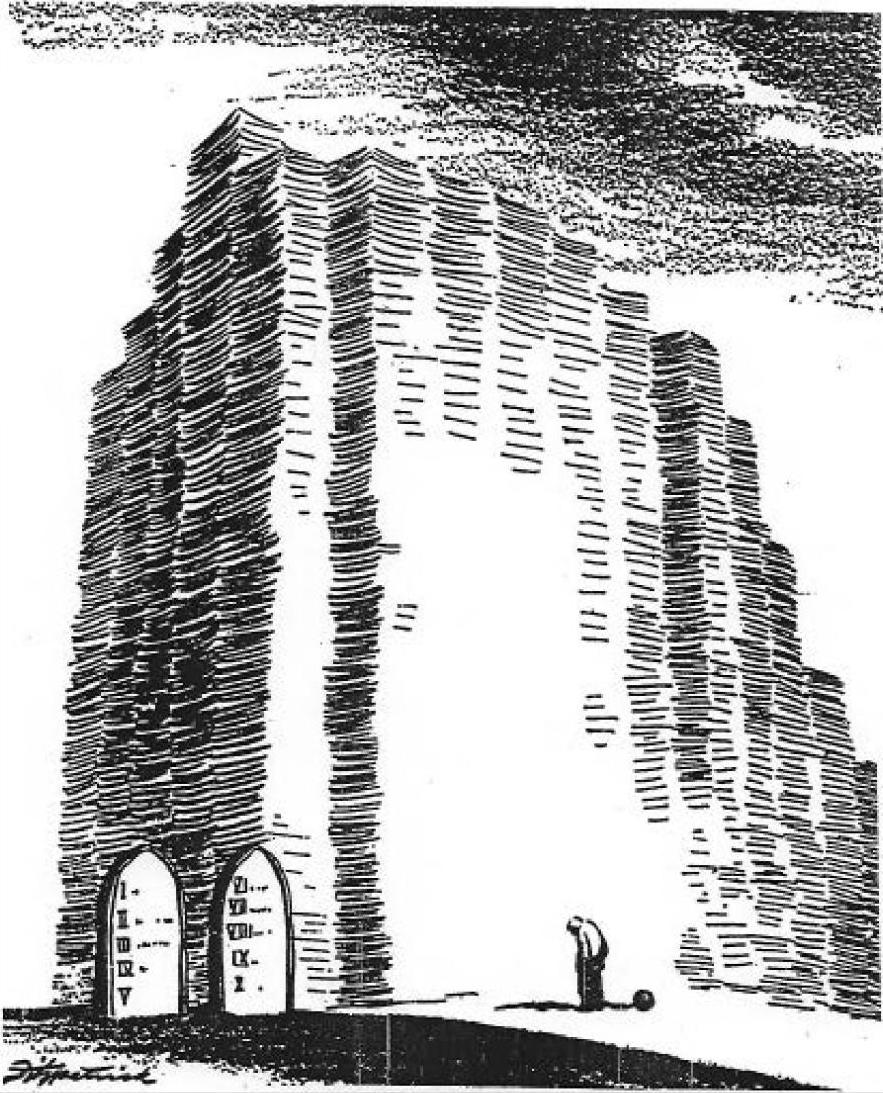
10 Commandments vs. modern law
Artist: Daniel R. Fitzpatrick | 1925
Image Info below footnotes

As we see from this insightful image from 1925 many things can be added to, misinterpreted, reinterpreted, suppressed, covered-up, and so forth, such that each person must be individually responsible to discern what is core and what is encumbrance — what is of God and what is of man — what is more or what is less than what God has ordained. There are other examples of Jesus breaking with tradition as well, such as extending the gospel to Samaritans and Gentiles, and being more inclusive of women.

As for our time, there is so much good in what the Prophet Joseph restored, so let us hold on to that good even if various powers may seek at times to sever some from that good. Let us be honest and forthright in our conscience and convictions, not insisting that others see as we see, nor alleging authority we do not have, but living our lives and testimonies with integrity, as the Spirit directs, come what may.

--------------------------------------------------/
1. https://dejavu-timestwo.blogspot.com/2022/03/speaking-truth-to-power-new-testament.html
2. JST Jesus to His disciples (Black and red bold is JST):
   6 And Jesus said unto his disciples, Beholdest thou the scribes,* and the Pharisees, and the Priests, and the Levites? They teach in their synagogues, but do not observe the law, nor the commandments; and all have gone out of the way, and are under sin.
   7 Go thou and say unto them, Why teach ye men the law and the commandments, when ye yourselves are the children of corruption?

   8 5 Say unto them, Thou hypocrite Ye hypocrites, first cast out the beam out of thine own eye eyes; and then shalt thou see clearly to cast out the mote out of thy brother’s eye.
   9 Go ye into the world, saying unto all, Repent, for the kingdom of heaven has come nigh unto you.
JST New Testament | Matthew 7:6–9 from Lutes, Kenneth and Lyndell. Joseph Smith Translation (p. 2124). Lutes Publishing. Kindle Edition.
Additional under #1:
  35 ¶ And Jesus answered and said, while he taught in the temple,
(New Testament | Mark 12:35)
  1 AND it came to pass, that on one of those days, as he taught the people in the temple, and preached the gospel, the chief priests and the scribes came upon him with the elders,
(New Testament | Luke 20:1)

Image info.
Page URL: https://commons.wikimedia.org/wiki/File:The_Laws_of_Moses_and_the_Laws_of_Today.jpg
File URL: https://upload.wikimedia.org/wikipedia/commons/b/bd/The_Laws_of_Moses_and_the_Laws_of_Today.jpg

Attribution: Daniel R. Fitzpatrick, Public domain, via Wikimedia Commons
Description: An editorial cartoon contrasting the proliferation of modern laws to the brevity of the Ten Commandments. Winner of the 1926 Pulitzer Prize for Editorial Cartooning.
Date: 12 April 1925
Source: St. Louis Post-Dispatch, April 12, 1925. Reprinted in Caricatures on American Historical Phases 1918-2018 (ed. Heinz Dietrich Fischer), via Google Books
Permission: Public Domain
Author: Daniel R. Fitzpatrick 1891 - 1969